
Fashion AI Trend Prediction for Social Commerce Launch Cycles
Fashion AI trend prediction models can compress your social commerce launch cycles from months to days. Here's the playbook any vertical can steal.
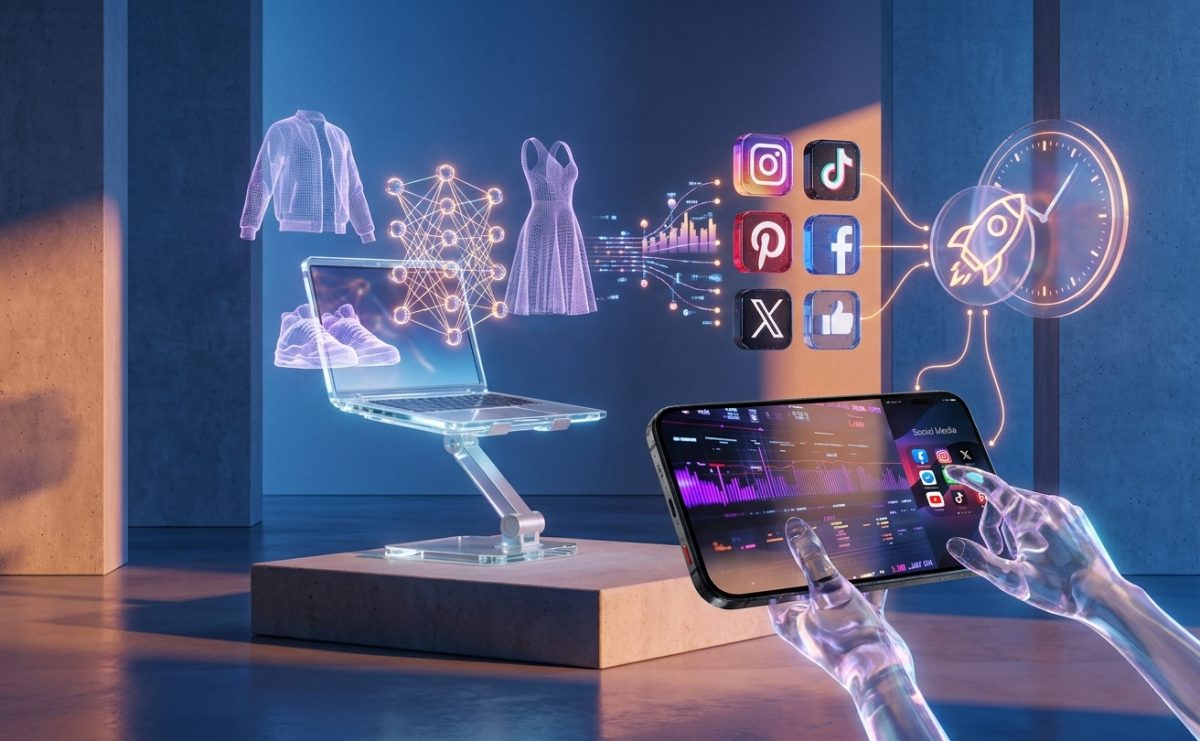
Fashion AI trend prediction models now compress design-to-market cycles from 18 months to under 72 hours. That stat, highlighted in Fashion Law’s April 2026 analysis, should matter to every social commerce team, not just apparel brands. The same ML frameworks forecasting next season’s dominant silhouettes can tell your team which product aesthetics, color palettes, and visual styles will flood Instagram and TikTok discovery feeds next month. The competitive advantage isn’t theoretical. It’s already being exploited by the fastest-moving social sellers across beauty, home décor, electronics, and food.
Spot trend-aligned buyer intent before competitors even see the signal.
What Fashion AI Trend Models Actually Ingest
Before you can adapt these models, you need to understand what they consume. Fashion AI trend forecasting platforms like Heuritech, Stylumia, and Google’s own trend prediction tools ingest four primary data streams: runway imagery from global fashion weeks, street style photography scraped from social platforms, social engagement velocity on emerging aesthetic hashtags, and search query acceleration from Google Trends and marketplace search bars. Each data stream serves a distinct predictive function. Runway imagery establishes directional intent from designers. Street style photography captures adoption signals. Social engagement velocity measures how fast a micro-trend is spreading. And search query acceleration confirms when consumers start actively seeking that trend.
The critical insight? None of these data types are fashion-specific in principle. They represent a universal signal architecture: professional tastemaker output, real-world adoption evidence, social amplification metrics, and commercial intent signals. Any vertical can map its own equivalents onto this framework.
Translating Fashion Inputs to Non-Fashion Verticals
Let’s get concrete. If you sell home décor, your “runway imagery” equivalent is professional interior design content from platforms like Dezeen, Architectural Digest, and design fair coverage from Milan’s Salone del Mobile or High Point Market. Your “street style” equivalent is user-generated room tours on TikTok and Pinterest boards with accelerating save rates. Social engagement velocity maps directly: track hashtag growth rates for aesthetic categories like #quietluxuryhome or #dopaminedecor. Search query acceleration works identically through Google Trends and marketplace search data from Wayfair, Amazon, or Etsy.
For beauty, substitute runway looks with editorial beauty content from major publications and MUA (makeup artist) portfolios. Street style becomes “get ready with me” content and real-world beauty hauls. Electronics teams can track design language trends from CES coverage, tech influencer unboxing aesthetics, and the visual styling of product photography that drives the highest engagement. Food brands should monitor plating aesthetics, ingredient trend velocity, and the visual language of viral recipe content.
Key Insight
The model doesn't care whether it's predicting the rise of butter yellow in fashion or the dominance of terrazzo patterns in home goods. The math is identical. What changes are the inputs.
Connecting Trend Forecasting APIs to Your Content Calendar
Here’s where this shifts from interesting to actionable. Several trend forecasting platforms now offer API access that social commerce teams can integrate directly into content planning workflows. The process follows a clear sequence.
Select Your Signal Sources:
Choose 2-3 trend forecasting APIs relevant to your vertical. Heuritech and Stylumia serve fashion and adjacent categories. Google Cloud Vision AI and Google Cloud’s trend tools can analyze visual trend patterns across any category. Supplement with social listening tools that track hashtag velocity and engagement acceleration.
Define Your Trend Taxonomy:
Map the specific visual attributes that matter for your products. This includes color palettes, texture categories, shape language, styling contexts, and aesthetic moods. Fashion models track attributes like "oversized," "structured," "earth tones," and "maximalist print." Your taxonomy should reflect your category’s visual vocabulary.
Set Prediction Windows:
Configure your API pulls to deliver predictions across three time horizons: 30-day (tactical content), 60-day (campaign planning), and 90-day (product merchandising and inventory). The 30-day window is your social commerce sweet spot.
Automate Calendar Triggers:
When a trend signal crosses your defined velocity threshold (we recommend a 40% week-over-week engagement increase as a starting trigger), auto-populate your content calendar with a brief, suggested visual direction, and recommended posting window. Teams using AI-powered micro-trend detection already have infrastructure for this kind of signal processing.
Validate Against Purchase Intent:
Not every visual trend converts to purchases. Cross-reference trend signals against actual buyer intent data. This is where tying social conversations to revenue becomes essential. A trending aesthetic only matters if people are also searching, comparing, and buying within that visual category.
Generating Trend-Aligned Creative Before the Peak
Timing is everything, but creative production has traditionally been the bottleneck. By the time a team identifies a trend, briefs a photographer, schedules a shoot, edits assets, and publishes, the trend has either peaked or saturated. Fashion AI models solve this by enabling predictive creative generation. Social commerce teams should steal the same playbook.
AI image generation tools (Midjourney, Adobe Firefly, DALL-E 3) can now produce product photography and lifestyle imagery that aligns with predicted visual trends in minutes. The workflow looks like this: your trend API flags that “soft matte textures with sage green accents” will hit peak discovery engagement in 18 days. Your creative team (or AI pipeline) generates product imagery styled with those exact attributes. You queue shoppable content for publication 5-7 days before the predicted peak. When the trend hits critical mass, your content is already indexed, already earning engagement, and already converting.
This is the same logic fashion retailers like Zara and Shein use to compress concept-to-shelf timelines. They just apply it to physical garments. Your version applies it to content and campaign creative, which is even faster because there’s no manufacturing lag. For teams already exploring AI video and catalog pipelines, adding trend prediction as an upstream input is a natural extension.
Timing Shoppable Content to Trend Critical Mass
The most sophisticated fashion AI models don’t just predict what will trend. They predict when a trend will reach specific adoption milestones. This temporal precision is gold for social commerce.
Meta’s and TikTok’s discovery algorithms heavily favor content that matches emerging interest patterns. Publishing shoppable content during the “acceleration phase” of a trend (when engagement velocity is climbing but hasn’t plateaued) generates dramatically higher organic reach than publishing during the peak or decline. Fashion Law’s analysis found that brands publishing trend-aligned content 7-14 days before peak adoption saw 3x higher conversion rates compared to those publishing at peak.
Key Insight
The goal isn't to ride the wave. It's to be the wave. When your shoppable content is what people discover as they first encounter a trend, you own the conversion moment.
To execute this, monitor the ratio between search volume growth and social engagement saturation. When search queries for a trend are accelerating but social feed saturation (measured by post volume) is still low, you’re in the optimal launch window. Google Trends provides the search acceleration data. Platform-native analytics and third-party tools like Sprinklr provide the saturation metrics.
Why This Matters Beyond Fashion
Social commerce is becoming visual-first across every category. TikTok Shop, Instagram Shopping, and Pinterest’s shoppable pins all rely on visual discovery. That means the visual characteristics of your product content directly determine whether algorithms surface it to potential buyers. Trend prediction models give you the ability to match your visual output to what discovery algorithms are about to prioritize.
Consider what happens without this capability. Your team creates content based on last month’s best performers. By the time it publishes, the visual language has shifted. Engagement drops. Algorithms deprioritize your content. Competitors who anticipated the shift capture the traffic you lost. This cycle repeats, and the gap widens.
Teams using shoppable tags in Reels and Stories are already positioned to move fast once a trend is identified. Adding predictive trend intelligence upstream means they’re not just fast. They’re first.
The playbook is straightforward: map your vertical’s signal equivalents to fashion AI’s four-input framework, connect trend APIs to your content calendar, generate creative assets that match predicted visual trends before those trends peak, and publish shoppable content during the acceleration window. The brands that operationalize this loop will consistently appear in discovery feeds at the exact moment consumer interest surges. Everyone else will be reacting.
FAQs
Can non-fashion brands actually use fashion AI trend prediction models?
Yes. The underlying ML architecture of fashion trend prediction models analyzes visual patterns, engagement velocity, and search acceleration. These signals exist in every consumer vertical. Home décor, beauty, electronics, and food brands can substitute their own category-specific visual data inputs and get the same predictive value from the same model types.
What tools or APIs are available for trend prediction outside of fashion?
Google Cloud Vision AI, Heuritech (expanding beyond fashion), and general-purpose social listening platforms with visual trend analysis capabilities all offer API access. Google Trends and Pinterest Trends provide free search acceleration data. Combining these with engagement velocity tracking from native platform analytics creates a functional trend prediction stack for any vertical.
How far in advance can AI trend models predict visual trends?
Fashion-grade models reliably predict trends 30-90 days out, with accuracy decreasing as the time horizon extends. For social commerce content purposes, the 14-30 day prediction window offers the best balance of accuracy and actionability. This gives teams enough lead time to generate creative assets and schedule shoppable content before the trend reaches critical mass.
Do I need a data science team to implement trend prediction for social commerce?
Not necessarily. Many trend forecasting platforms now offer no-code dashboards and API integrations designed for marketing teams. The key requirement is defining your visual trend taxonomy clearly so the tools know what attributes to track. A technically proficient marketer can configure most of these integrations without dedicated data science support.
Launch Trend-Aligned Campaigns Before Competitors React
Predictive trend intelligence only works when it connects to real buyer intent. Intercept identifies the exact moment trend-driven demand converts into purchase signals, so your campaigns capture revenue at peak momentum.


