
AI Cyberattacks Targeting Your Martech Stack
AI-powered cyberattacks now target marketing data infrastructure. Learn how CMOs and COOs can protect intent pipelines, CDPs, and attribution systems.
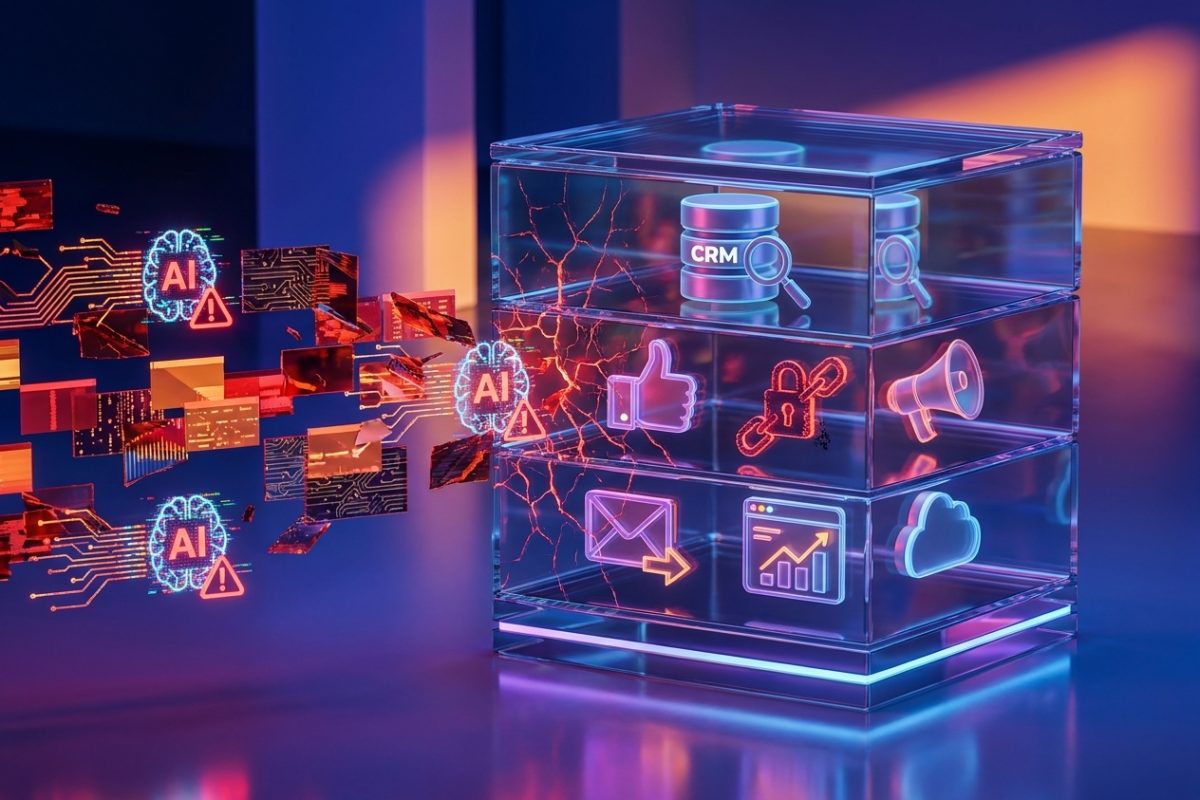
A polymorphic phishing attack generated by AI can now craft, launch, and exfiltrate data in under 60 seconds — faster than any SOC analyst can triage an alert. That stat, pulled from CrowdStrike’s threat research, should terrify every marketing leader who relies on real-time data pipelines. Because here’s the thing: attackers aren’t targeting your firewall anymore. They’re targeting your CDP. Your cross-platform attribution graph. Your AI-powered cybersecurity defenses are being outpaced by AI-powered offenses — and marketing data infrastructure is emerging as the soft underbelly that nobody on your security team is watching closely enough.
Protect your intent data pipelines — see how Intercept secures real-time buyer signals at scale.
Why Marketing Infrastructure Became the Softest Target
Security teams have spent decades hardening financial systems, HR databases, and customer PII stores. Martech stacks? They’ve largely flown under the radar. Yet modern marketing infrastructure handles data that’s arguably more exploitable: real-time behavioral signals, purchase intent scores, audience segments synced across Meta, Google, TikTok, and programmatic DSPs. A compromised CDP doesn’t just leak emails — it leaks your entire commercial strategy.
Consider what a unified intent graph actually contains. Cross-platform user journeys. Propensity models. Bidding logic derived from sentiment data. An attacker who gains access to this infrastructure doesn’t need to steal credit card numbers. They can poison your attribution data, redirect your spend, or — worst case — silently siphon competitor intelligence from your own data flows for months before anyone notices.
The reason this is escalating now is speed. AI-accelerated attacks have eliminated the traditional “dwell time” window. IBM’s security research shows that the average breakout time — the interval between initial compromise and lateral movement — dropped below 2 minutes for AI-augmented attacks. Your martech stack, with its dozens of API integrations, webhook callbacks, and real-time data syncs, offers an attack surface that multiplies exponentially with every new tool you add.
The Anatomy of an AI-Accelerated Martech Attack
Let’s walk through a realistic scenario that most CMOs haven’t considered.
An attacker uses a large language model to generate a convincing integration request — impersonating a vendor your team already uses, say a measurement partner or a creative optimization platform. The phishing payload targets a marketing ops manager, not an IT admin. It exploits OAuth tokens rather than passwords. Within seconds of gaining access, an AI agent begins mapping your CDP’s data schema, identifying high-value audience segments, and establishing persistent access through legitimate-looking API calls that blend seamlessly with your normal Segment or mParticle traffic.
No alarms fire. Why would they? The API calls look identical to your regular data syncs.
Key Insight
The most dangerous martech breaches don't look like attacks — they look like normal platform operations. That's precisely why traditional security monitoring misses them entirely.
Meanwhile, the attacker can accomplish multiple objectives simultaneously: exfiltrate your highest-performing audience segments to a competitor, inject poisoned conversion data that warps your predictive budget allocation models, or subtly alter attribution signals so your media mix modeling drifts toward channels that benefit a third party. This isn’t theoretical. Variants of this attack pattern have already been documented in the wild.
Identifying Your Most Vulnerable Martech Assets
Not all marketing technology carries equal risk. You need to triage ruthlessly. Here’s a framework for identifying which assets demand immediate hardening:
Map Every Data Integration Point:
Catalog every API connection, webhook, server-to-server sync, and JavaScript tag firing across your martech stack. Pay special attention to OAuth tokens and service accounts that haven’t been rotated in over 90 days. Most marketing teams have 3-5x more active integrations than they realize.
Classify Data by Exploitability:
Raw PII matters, but intent signals and audience segments are often more commercially valuable to attackers. Score each data flow by asking: "If a competitor had this data, how much damage could they inflict?" Your real-time bidding signals and conversion data often rank higher than you’d expect.
Identify Single Points of Failure:
Which platform, if compromised, would cascade across your entire measurement stack? For most organizations, it’s the CDP or the attribution platform. If your cross-platform attribution system feeds budget decisions across every channel, that’s your crown jewel — and your biggest liability.
Audit Third-Party Data Sharing:
Every data clean room partnership, every measurement vendor, every agency with platform access represents a potential entry point. Review access permissions with the same rigor your security team applies to production databases. Tools like Gartner’s martech audit frameworks can help structure this process.
Stress-Test Your Anomaly Detection:
Can your current monitoring distinguish between a legitimate spike in conversion events (say, from a viral campaign) and an injection attack that mimics that spike? If the answer is no — and for most marketing teams it is — you have a critical blind spot.
AI-Driven Anomaly Detection on Data Flows: What Actually Works
Traditional SIEM tools weren’t built to monitor martech traffic patterns. They can catch a brute-force login attempt, but they’re useless against an attacker who’s using valid OAuth credentials to make API calls that look identical to your normal Segment event stream.
What you need is anomaly detection specifically trained on your marketing data flows. This means establishing behavioral baselines for every integration: typical event volume, payload structure, timing patterns, geographic origins of API calls. When a data sync that normally pushes 50,000 events per hour suddenly pushes 500,000 — or when API calls start originating from an IP range you’ve never seen — an AI-driven monitoring layer should flag it instantly and, ideally, auto-quarantine the connection.
Several approaches work well in practice. First, deploy ML models that learn the “normal” cadence of your data pipelines. Services like Datadog, Splunk, and custom implementations built on platforms like Apache Kafka with anomaly detection plugins can monitor event streams in near real-time. Second, implement cryptographic verification on data payloads — a practice that’s emerging in quantum-safe cryptography migration roadmaps but applies equally to current-generation threats. Third, create “canary” data records — synthetic audience segments or fake conversion events that should never appear in downstream systems. If they do, you’ve been compromised.
Key Insight
The best anomaly detection doesn't just monitor for known attack signatures — it learns what "normal" looks like for your specific data flows and alerts on any deviation, no matter how subtle.
Building Incident Response Playbooks for Campaign Continuity
Here’s where most organizations fail catastrophically. They have incident response plans for data breaches. They have none for marketing data breaches. The difference matters enormously because the operational impact is completely different.
When your CDP gets compromised mid-campaign, you’re not just dealing with a security event. You’re dealing with live ad spend burning against poisoned audience data, attribution models producing garbage outputs, and potentially millions of dollars in budget being misallocated in real time. Your IR playbook needs to account for this reality.
Establish a Marketing-Security Joint Response Team:
This isn’t optional. Your CMO and CISO need a pre-defined escalation path. Identify one person on each team who speaks the other’s language — someone who understands both API security and campaign operations. This role doesn’t exist in most org charts, which is exactly the problem.
Pre-Stage Failover Configurations:
If your primary CDP is compromised, can you fail over to a backup within minutes? If your attribution platform goes dark, do you have a manual attribution model (even a crude one) ready to deploy? Pre-stage these so you’re not building them during a crisis.
Define "Campaign Kill Switch" Protocols:
Know exactly which campaigns to pause and which to let run. Not all campaigns are equally exposed. Campaigns relying on first-party intent data from your CDP are high-risk; campaigns using contextual targeting may be unaffected. Map this in advance.
Drill It Quarterly:
Run tabletop exercises where a simulated attacker compromises your sentiment data and AI strategy infrastructure. Time how long it takes your team to detect, contain, and recover. Most teams are shocked by how slow they are the first time.
The CMO-COO Partnership That Security Demands
This isn’t a problem that lives neatly in one executive’s domain. The CMO owns the martech stack and the data it produces. The COO owns operational risk and business continuity. The CISO owns security tooling and threat detection. When AI-powered attacks target marketing infrastructure, all three are in the blast radius — and none of them can solve it alone.
The practical first step? Get your martech architecture diagram into your next security review meeting. Not a PowerPoint overview — the actual diagram showing every data flow, every API connection, every third-party integration. Security teams consistently tell us they’ve never seen it. That gap between marketing operations and security operations is exactly where attackers live.
At Intercept, built by Moburst, we see this firsthand in how intent data pipelines operate. Real-time buyer signals flowing across platforms create enormous commercial value — but also enormous exposure if those pipelines aren’t hardened against manipulation. Understanding how algorithms rank brand signals is only half the equation; ensuring those signals can’t be tampered with is the other half, and it’s the half that most marketing teams haven’t addressed.
Your martech stack is now critical business infrastructure. Treat its security that way, starting this week — not after the breach that forces you to.
FAQs
Why are AI-powered cyberattacks specifically targeting marketing data infrastructure?
Marketing data infrastructure contains high-value commercial intelligence — audience segments, intent signals, bidding strategies, and attribution data — that is often less protected than traditional IT assets. AI-accelerated attacks can exploit the numerous API integrations and real-time data syncs in martech stacks, making them attractive soft targets with significant commercial payoff for attackers.
How fast can AI-accelerated cyberattacks compromise marketing systems?
AI-augmented attacks can achieve initial compromise and begin lateral movement in under two minutes. Polymorphic phishing attacks generated by AI can craft, launch, and begin data exfiltration in under 60 seconds — far faster than human security analysts can detect and respond to threats using traditional monitoring tools.
What marketing technology assets are most vulnerable to cyberattacks?
Customer Data Platforms (CDPs), cross-platform attribution systems, and real-time intent data pipelines are the most vulnerable and highest-value targets. Any system with multiple API integrations, OAuth token-based authentication, and real-time data syncing across platforms represents a significant attack surface that standard security tools often fail to monitor effectively.
How should CMOs and security teams collaborate to protect martech infrastructure?
CMOs should share detailed martech architecture diagrams — including all data flows, API connections, and third-party integrations — with security teams during regular security review meetings. Organizations should establish a joint marketing-security response team, define campaign kill-switch protocols, and run quarterly tabletop exercises simulating attacks on marketing data systems.
What is AI-driven anomaly detection for marketing data flows?
AI-driven anomaly detection uses machine learning models trained on the normal behavioral patterns of your specific marketing data pipelines — including event volumes, payload structures, timing patterns, and API call origins. When activity deviates from these baselines, the system flags or auto-quarantines the suspicious connection, catching attacks that traditional security tools would miss because they use valid credentials and mimic normal operations.
Secure Your Intent Data Before Attackers Do
AI-powered threats targeting martech infrastructure demand real-time protection of your buyer signal pipelines. Intercept helps you capture and safeguard high-value intent data across every platform your buyers use.


